


When people ask me whether they should buy an automatic or a semi-automatic carton sealer, I never answer immediately. Not because it’s a trick question, but because the wrong choice often comes from thinking about “machines” instead of thinking about the actual workflow. And after working with different factories, distributors, and even some niche exporters over the years, I’ve noticed that most teams don’t really want the fastest machine—they want the one that keeps the line moving without drama.
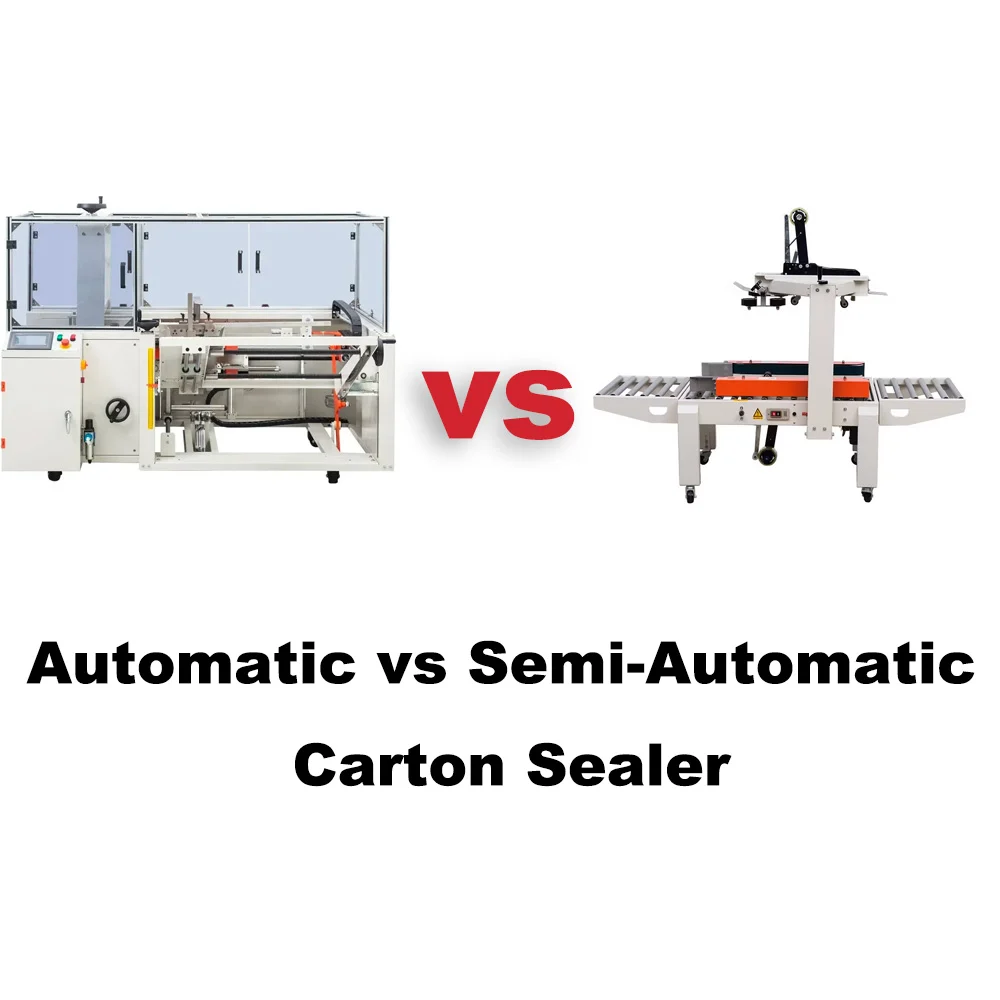
If you’re new to this topic, you may want to read the fundamentals first: What Is a Carton Sealer?
But if you’re already familiar with carton sealers and you’re stuck between the automatic and semi-automatic options, let’s go through this comparison in a way that mirrors how real warehouses make decisions—not how catalogs describe them.
Speed: The Most Misunderstood Comparison
Speed is the first metric buyers look at, but ironically, it’s the least reliable way to predict real-world performance. I’ve seen factories buy a fast machine only to discover that their upstream packing process can’t feed cartons quickly enough. And I’ve seen small teams outperform their machine specs simply because their operators had great rhythm and experience.
In theory:
- Automatic sealers have higher sealing speeds and can maintain that speed all day.
- Semi-automatic sealers depend heavily on the operator’s pace and consistency.
But theory doesn’t reflect what really happens on a box line. Here’s what matters more:
1. Box Uniformity
If most of your cartons are the same size, automatic machines shine. They maintain a steady pace with minimal operator involvement. A semi-automatic machine can also perform well, but operators fatigue over long shifts.
2. Box Quality
Weak corrugated board slows semi-automatic work because the operator must be more careful. Automatic sealers, with their flap-folding systems, often handle flimsy cartons more consistently.
3. Packing Rhythm
In operations where boxes come in waves—morning slow, afternoon busy—the speed difference becomes more pronounced. Automatic machines crush the peak hours because they don’t slow down when humans do.
For choosing the right speed based on your workflow, this guide may help: How to Choose the Right Carton Sealer
Labor Needs: The Hidden Cost Most Buyers Don’t Calculate
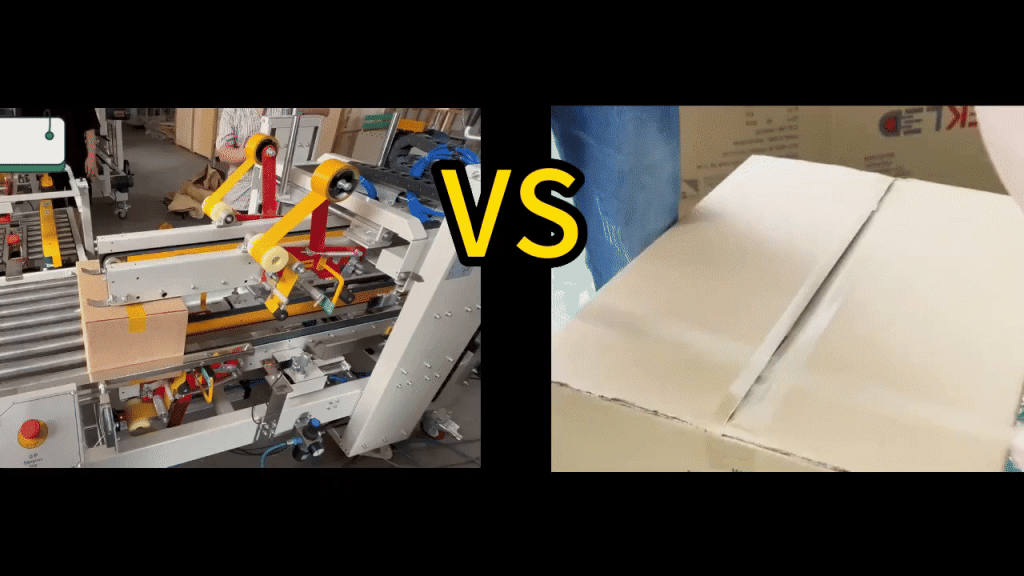
Labor is where the automatic vs semi-automatic divide becomes painfully clear. No matter how cheap the semi-automatic machine is, extra labor adds up—fast. And in many regions, hiring warehouse workers is harder than budgeting for equipment.
Semi-Automatic Sealers: Good for Skilled Operators
Semi-automatic units rely on people to fold flaps and feed boxes. With a motivated and experienced team, they perform surprisingly well. I once watched a three-person packing line in a small electronics operation reach speeds that rivaled automatic systems. But that was only possible because the same operators handled the machine daily and had strong muscle memory.
Automatic Sealers: Good for Unpredictable Workforces
If your team changes often, if turnover is high, or if seasonal workers join every few months, automatic sealers win instantly. They remove the most training-intensive step: flap folding.
I’ve watched companies struggle every time a new worker joins. Manual flap folding is harder than it looks. Automatic sealers solve that problem entirely.
Labor Efficiency in Mixed Workflows
When packing shifts between fast and slow periods, semi-automatic machines feel easier to control because operators can adjust their pace. But automatic systems reduce the mental load—they handle the “boring part” the same way every time, allowing workers to focus on loading and quality control.
Price: The Number Everyone Focuses On—Often Too Much
Price is usually the first argument in favor of semi-automatic machines. They’re cheaper. Sometimes half the price of automatic sealers. And yes, if you’re sealing only a few hundred boxes per day, semi-automatic models are more than enough.
But a mistake I often see is treating machine price like the only cost. It isn’t. Here’s what companies forget to include:
- Operator wages across the machine’s lifetime
- Tape waste caused by fatigue or rushed taping
- Lower throughput during peak hours
- Downtime when operators take breaks
- Training time for new workers
Automatic Sealers: Higher Initial Cost, Lower Lifetime Cost
Automatic sealers look expensive until you calculate the real cost of labor and inefficiency. In one mid-sized food company I visited, switching to automatic saved them almost 30% in labor hours during peak season. No one expected that number—they bought the machine because the warehouse manager was tired of fixing uneven seals.
Semi-automatic Sealers: Budget-Friendly and Flexible
These are ideal when budgets are tight or when the packing workload fluctuates. Many small exporters start with semi-automatic units to learn their rhythm before investing in automation. They’re also easier to move around, which matters in operations that constantly change layout.
Efficiency: Beyond Speed, Beyond Cost
Efficiency is not just about how fast a box gets sealed. It’s about how smoothly the entire workflow operates. This is where automatic and semi-automatic machines behave differently.
Automatic Sealers: Excellent for Predictable Lines
If your production line has consistent output and stable product sizes, an automatic sealer ties everything together. The machine becomes part of the rhythm, not a point of friction.
Automatic units also integrate better with conveyors, labelers, and strapping machines. If you scale later, the automatic sealer won’t become a bottleneck.
Semi-Automatic Sealers: Better for Hands-On Workflow
Some teams prefer the human touch. They need to inspect products manually. They open boxes for spot checks. They adjust taping based on product fragility. Semi-automatic sealers work beautifully in these scenarios because operators stay in control.
But that control comes at the cost of variability—humans aren’t as consistent as rollers and tape heads.
If you’re worried about long-term reliability, here’s a guide that can save headaches later: Carton Sealer Maintenance
ROI: The Only Metric That Really Matters to Management
| Feature | Automatic Sealer | Semi-Automatic Sealer |
| Throughput | High & Consistent | Variable (Operator Dependent) |
| Labor Skill | Minimal (No flap folding) | Moderate (Requires rhythm) |
| Box Size | Best for Uniform Batches | Flexible for Random Sizes |
| Initial Cost | $$$ | $ |
| Best For | High volume, unstable workforce | Low volume, skilled teams |
Return on investment isn’t about speed. It’s about removing unnecessary costs, preventing slowdowns, and reducing human error. And unlike speed or price, ROI varies wildly depending on your operation.
When Automatic Sealers Deliver Better ROI
- You seal more than 500 boxes per shift.
- Your workforce changes frequently.
- Your cartons are large, heavy, or tiring to fold manually.
- Your product is fragile or high-value.
- Your peak seasons cause bottlenecks.
- Your packing line is (or will be) partially automated.
In these scenarios, the automatic sealer pays for itself shockingly fast—often within months.
When Semi-Automatic box taping machine Deliver Better ROI
- Your box volumes are moderate.
- Your team is consistent and well-trained.
- Your cartons vary heavily in size.
- Your budget is limited.
- You want a low-maintenance, easy-to-move machine.
For small or growing businesses, semi-automatic models hit a sweet spot between cost and performance.
And if you want a deeper look at which industries lean toward which type, you may find this useful: Industries That Use Carton Sealers
Looking at Real Machine Examples Helps
If you’d like to see what a modern box taping sealer looks like in a real product line, here’s our product page: Automatic Carton Sealer — Product Page
For broader packaging industry trends and professional insights, PMMI offers excellent resources.
Final Thoughts
The difference between automatic and semi-automatic carton taper is not a battle of “better vs worse.” It’s a question of workflow, people, space, product, and long-term plans. I’ve seen tiny teams thrive with semi-automatic machines because they had rhythm and skill. I’ve seen large factories fail with semi-automatic units because their workflow demanded consistency only an automatic machine could deliver.
The best choice is the one that fits your actual reality—not just the machine specs on paper.
If you haven’t read the buying guide yet, it pairs perfectly with this article: How to Choose the Right Carton Sealer