


If you’ve ever watched a warehouse team sealing boxes at the end of a packing line, you know it looks simple from the outside. But anyone who has spent time around real production floors—especially in growing small and mid-sized companies—knows that sealing cartons consistently is one of those “small” tasks that can quietly slow everything down. I’ve seen teams lose entire afternoons because tape rolls kept breaking, boxes wouldn’t stay square, or the sealing line became a bottleneck during peak days.
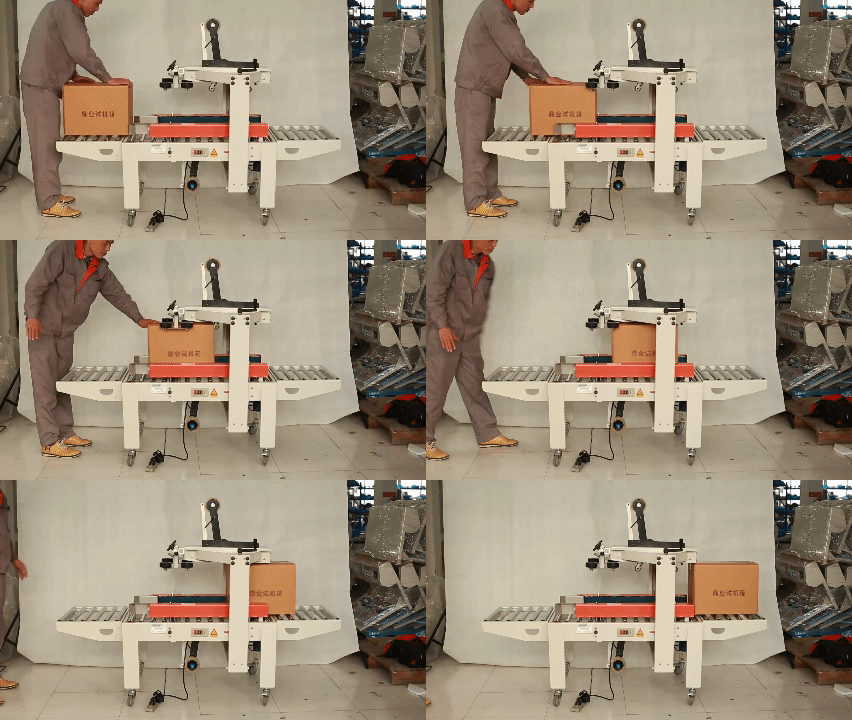
That’s usually the moment someone on the team says: “We need a carton sealer.” And surprisingly, many people nod along without really knowing what that means. So let’s break it down—without the buzzwords, without the encyclopedia-style tone, and definitely without pretending that all warehouses run like textbook diagrams.
Why Carton Sealers Matter More Than People Expect
Before defining anything, I want to start with what I’ve observed in real operations. A warehouse manager once told me, “Taping boxes is the least technical job here, but it causes the most complaints.” Tape guns slow down. Workers lose rhythm. Someone’s wrist hurts. And every time a busy team rushes, tape waste skyrockets. You won’t notice it on day one, but give it a month, and you’ll see pallets stacked with tape rolls that should have lasted twice as long.
This is the real reason carton sealers exist: not to be fancy machines, but to create predictable output. Predictable tape use. Predictable box closures. Predictable throughput. And for growing businesses, predictability beats speed every time.
Now let’s talk about what a carton sealer actually is.
So, What Exactly Is a Carton Sealer?
A carton sealer is a machine that applies tape to the top, bottom, or both sides of a cardboard box. Instead of a person guiding the tape along an edge, the machine does it with a combination of rollers, guides, and a tape head. The result is consistent seals, fewer mistakes, and less physical strain on workers.
But the more interesting part is what this machine represents. It’s usually the first piece of automation a warehouse buys. Not conveyors, not robotic arms—just a simple sealer. Because it solves a universal problem without requiring big changes to the workflow.
One operator loads the box. The machine does the sealing. That’s it. And that minimal friction is why sealers have become a kind of “gateway automation” for many factories.
Inside a Carton Sealer: The Components That Actually Matter
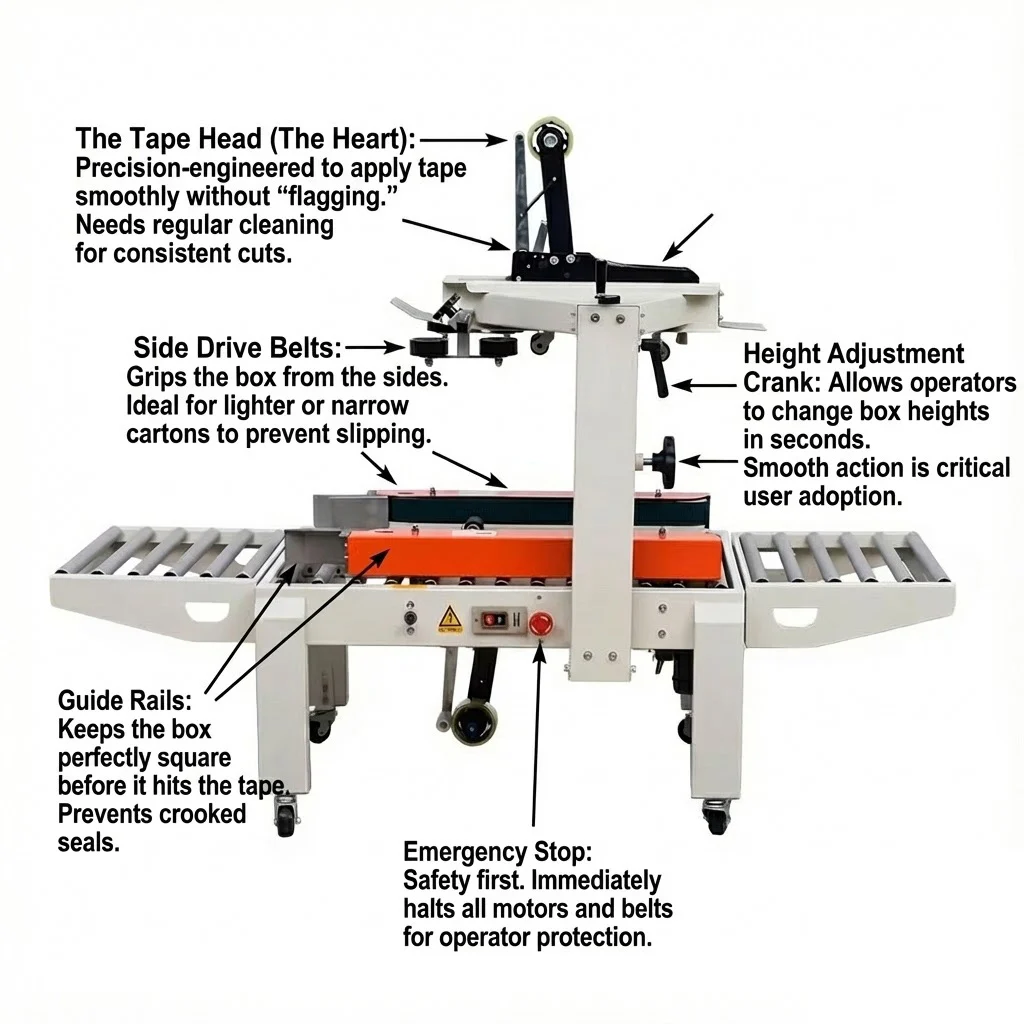
There are dozens of components on a typical sealer, but after working with manufacturers and end-users, I’ve found that only a handful truly shape performance. Let me walk through them—not as a parts list, but as elements that influence reliability.
1. The Tape Head
This is the heart of the machine. If the tape head is poorly designed, nothing else saves the process. Good tape heads pull tape smoothly, cut cleanly, and avoid “flagging”—when tape lifts up at the edges. A common mistake small manufacturers make is buying cheap heads that gum up quickly, especially with low-cost tape brands.
2. Side Drive or Bottom Drive Belts
These belts pull boxes forward. Side-drive belts handle narrow boxes better. Bottom-drive belts are great for uniform cartons but struggle with very lightweight ones. And yes, I’ve seen companies switch machines simply because someone forgot to consider box weight during purchasing.
3. Guide Rails
Good rails square the box before sealing. If they’re flimsy, you’ll hear operators complain immediately because boxes tilt, jam, or drift. Rails seem boring—but if your line packs fragile products, squareness is everything.
4. Adjustment System
Some teams change carton sizes only twice a day. Others adjust every 10 minutes. If your operator hates the adjustment knobs, the entire line slows down. I’ve watched operators push against rails instead of adjusting them—just to avoid touching the knobs. That tells you everything about how important usability is.
5. Frame and Build Quality
Factories with a lot of dust, humidity, or vibration need sealers with heavier frames. Light-duty frames slowly shift over time, and you’ll start seeing one side seal slightly off-center. When you’re sealing 500+ boxes an hour, that 2mm deviation becomes an annoying daily sight.
Not All Carton Sealers Are the Same: A Practical Look at Types
| Feature | Semi-Automatic Sealer | Automatic Sealer | Random-Sized Sealer |
| Best For | Uniform box sizes, small to mid-volume runs. | High-volume, identical box runs (batch processing). | E-commerce, mixed production lines with varying box sizes. |
| Operator Role | Folds flaps manually, pushes box into belts. | Only feeds the box (or fully automated feed). | Folds flaps manually (usually), machine adjusts to size. |
| Throughput Speed | Moderate (Dependent on operator speed). | High (Consistent, non-stop output). | Moderate (Machine needs ~2-3 seconds to adjust size). |
| Key Advantage | Cost-Effective: Low entry price, high reliability. | Efficiency: Removes the “flap folding” bottleneck. | Flexibility: Handles anything you throw at it without stopping. |
| Ideal Daily Volume | 50 – 500 boxes | 1,000+ boxes | 200 – 1,000+ mixed boxes |
Now we reach the part most guides simplify too much. Yes, the usual “semi-automatic vs automatic” distinction is correct. But buyers choose machines based on workflow, not textbook categories. So let me describe types through the lens of how teams actually use them.
1. Semi-Automatic Sealers
These machines require operators to fold the flaps manually. They’re popular with small warehouses because they’re inexpensive and easy to learn. One operator loads the box, pushes it forward, and the machine handles the tape.
People often underestimate how fast a trained operator becomes on a semi-automatic. I’ve seen experienced workers run them at speeds close to automatic systems—at least until fatigue kicks in.
More details here if you need deeper comparison: Automatic vs Semi-Automatic Carton Sealer
2. Automatic Sealers
Automatic sealers fold the flaps themselves. This is a huge relief in high-volume or repetitive operations. If your team handles hundreds of identical cartons per shift, an automatic sealer is practically guaranteed to pay for itself.
Where people get it wrong is thinking automation is always faster. In reality, the biggest win is consistency. You avoid the “good morning boxes, bad afternoon boxes” problem caused by operator fatigue.
3. Random-Sized Sealers
These are for businesses processing mixed carton sizes back-to-back. E-commerce fulfillment centers use them often because every box on the line might differ. The machine senses carton dimensions and adjusts instantly.
Honestly, this is where I’ve seen the fastest ROI—especially in companies transitioning from manual taping.
4. Custom Sealers for Niche Needs
Beverage companies, fresh food exporters, and even certain electronics suppliers sometimes need sealers with special guards, stainless frames, or modified drives. These aren’t common, but they exist because some production environments simply break standard machines.
Where Carton Sealers Show Their Real Value
You won’t appreciate a sealer by watching a promotional video. But observe a busy warehouse during peak season—late Q4, for example—and the value becomes obvious. Let me outline the most tangible gains, based not only on theory but on what I’ve seen in the field.
1. Less Fatigue, Better Output
Taping boxes manually is repetitive wrist-heavy work. Workers tire. Output drops. Tape waste rises. A sealer removes the strain. And when operators feel better, they stay longer and work smoother.
2. Predictable Tape Usage
Human taping varies wildly: some people double tape everything; others use too little. Machines don’t have such habits. This matters because tape is more expensive than most managers assume.
3. Clean, Professional Seals
If your boxes ship to retailers, distributors, or B2B clients, presentation matters. Uneven tape lines make a surprisingly poor impression. Sealers make every box look “retail ready.”
4. Faster Throughput With Fewer Errors
Human taping errors cause rework—and sometimes product damage. With a machine, you eliminate most of those small but frequent issues. And over thousands of boxes, that adds up.
5. Better Use of Labor
Any warehouse manager knows it’s harder than ever to hire packing-line labor. A carton sealer doesn’t replace people; it lets the same team accomplish more without burning out.
Applications: Where Carton Sealers Fit Into Real Operations
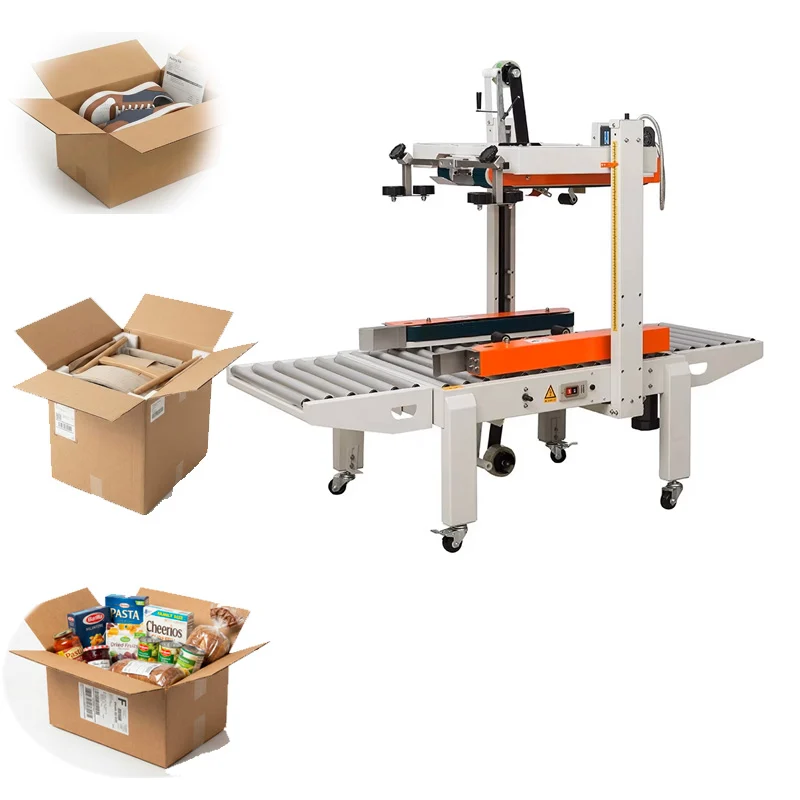
Instead of listing industries as if they all use sealers the same way, I’d rather share a few real patterns I’ve seen across factories.
E-commerce Fulfillment
These warehouses often face extreme daily swings. One morning is calm; the afternoon explodes with orders. Random-size sealers shine here because they adapt instantly.
Food Processing
Fresh products demand fast packing lines. Here, automatic sealers prevent bottlenecks between weighing, boxing, and palletizing. Stainless-steel models dominate in environments with moisture.
Furniture & Bulk Goods
Large, heavy cartons are awkward to tape by hand. Side-drive sealers and heavy-duty frames are common choices here.
If you’d like a deeper look at industries: Industries That Use Carton Sealers
Choosing a Carton Sealer That Actually Fits Your Workflow
People often choose a sealer by watching a YouTube demo. That’s fine for learning the basics, but it’s the wrong way to make a purchasing decision. The best way is to look at your workflow honestly—especially its weak points.
Some questions I always ask clients:
- Are box sizes uniform or mixed?
- Is manpower stable or unpredictable?
- Do operators change the machine settings often?
- Is tape waste a silent cost in your warehouse?
- Does your team tape boxes all day or only in bursts?
- Is your product fragile or high-value?
Your answers shape the machine you need far more than its catalog specs.
More structured guidance: How to Choose the Right Carton Sealer
Maintenance: The One Thing People Forget
Carton sealers are simple machines, but they’re not maintenance-free. Many companies forget this because the machines seem so basic. Then one day the tape head drags, a box jams, or belts slip—and output crashes.
My personal rule: small daily checks, bigger monthly ones.
- Clean tape residue from the tape head.
- Check belt tension.
- Lubricate moving parts as recommended.
- Inspect the blade—sharp blades matter.
- Test the squareness of the guide rails.
For a full detailed walk-through: Carton Sealer Maintenance: Complete Guide
Why the Type of Corrugated Box Matters More Than You Think
Many new buyers never consider this factor. But the structure of the corrugated board affects sealing performance. Boxes with weak sidewalls collapse under the rollers. Low-quality recycled board absorbs humidity and becomes soft. Oversized flutes resist folding.
If you want to understand corrugated box design in depth, these two resources are excellent:
- PMMI — packaging machinery industry insights
- Corrugated.org — board structure, strength, and carton design info
Carton Sealers Inside Larger Packaging Lines
Modern factories integrate sealers with conveyors, barcode scanners, automatic labelers, strappers, and palletizers. Even though a sealer is simple, it ends up being a critical link. When it stops, everything behind it piles up.
This is why choosing a machine that’s easy to maintain and easy to adjust matters more than raw speed. A machine that runs 5% slower but never jams will always outperform a faster but unreliable one.
And yes—your choice of sealer can influence your future automation path. It becomes the foundation that other equipment connects to.
When NOT to Buy a Carton Sealer
It might sound odd in a guide like this, but there are cases where a carton sealer is not the answer.
- If your packaging volume is extremely low.
- If your products require specialized closures (strapping, glue, staples).
- If your box sizes change faster than operators can adjust.
- If your cartons are very fragile or extremely soft.
In those cases, custom jigs, manual tools, or adhesive machines might fit better.
The Future of Carton Sealing
The industry is shifting toward smarter, safer, and more ergonomic machines. Some trends I’ve noticed:
- Tool-less adjustments becoming standard.
- Sensors for detecting folded flaps and misaligned boxes.
- Energy-efficient motors replacing old belt-driven systems.
- Integration-friendly frames with modular add-ons.
- Growing demand for machines that handle recycled board better.
Interestingly, many improvements are driven not by big corporations but by mid-sized factories pushing for better reliability.
Final Thoughts
Carton sealers may not be glamorous machines, but their impact on a packing operation is hard to ignore. They save labor, reduce waste, and make output predictable. And when chosen thoughtfully, they become one of the most reliable parts of a production line.
If you’re exploring automation for the first time, a carton sealer is often the smartest starting point—simple, affordable, and immediately effective.
You can also explore our complete category of carton sealers here: Carton Sealer Category Page